

Now the evening light has disappeared it’s time to practice with structure ready for next season. H16 Sale GC, Manchester UK
What is the best winter golf practice plan?
The best winter golf practice plan replaces aimless ball-striking with a structured, 60-minute routine divided into three distinct phases: a 15-minute low-point strike audit to expose false mat feedback, 30 minutes of randomized target play to simulate real course conditions, and a 15-minute post-session review to anchor your next practice milestone.
Definition: Junk Practice in golf refers to high-volume, rapid-fire ball-hitting (e.g., hitting 100 consecutive 7-irons from the same lie) without consequence, variable targets, or feedback loops. While it creates temporary muscle rhythm and dopamine hits, it does not transfer to outdoor course performance.
Every winter, thousands of golfers retreat to the heated bays of their local driving range or indoor simulator. They buy a bucket of 100 balls, pull out a 7-iron, and start swinging. By ball 85, they are sweating, swinging out of their shoes, and finally striping it dead straight.
They leave the bay feeling like they’ve cracked the code. Then April arrives, they step onto the first tee, and shoot exactly the same score they did last October.
This is the "Junk Practice" trap. Hitting balls without consequence, context, or feedback doesn't build skill; it just builds a fake dopamine loop. In fact, practicing all winter and returning in spring with the exact same handicap is exactly how I discovered Potentially in the first place.
If you want your winter bay sessions to translate to the scorecard next season, you need a blueprint.
The 60-Minute Winter Practice Framework
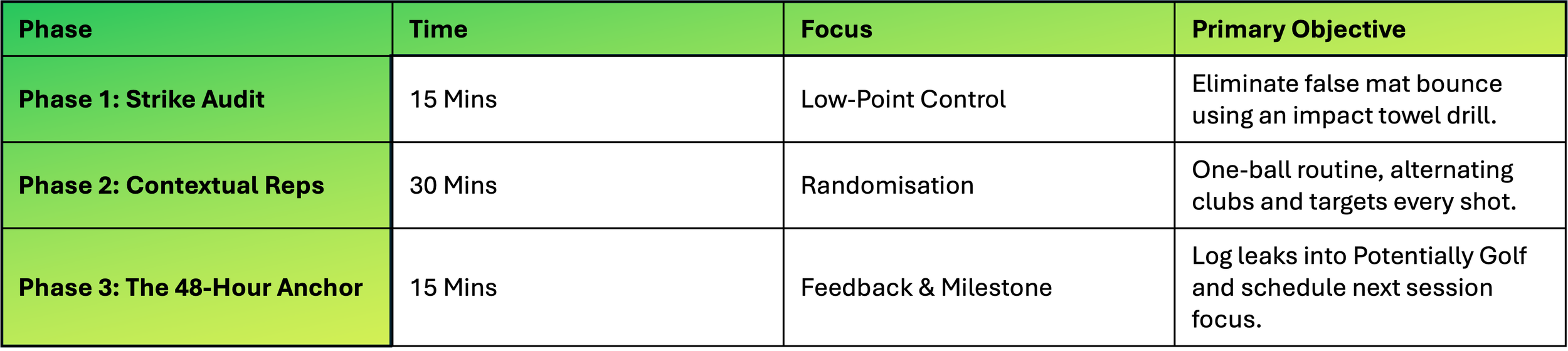
Table showing example practice plan on indoor sim or driving range bay
Phase 1: The Strike Audit (15 Minutes)
Before you look at ball speed or carry distance, you need to find out if your swing actually works or if your modern game-improvement irons are just masking a terrible strike.
Mats are notoriously forgiving. You can hit two inches behind the ball, and the club will simply bounce off the rubber base and into the ball, resulting in a perfectly acceptable shot on the screen. On a real golf course, that shot is a heavy chunk that travels 40 yards. Modern equipment is designed to hide your flaws. If you want to know how well you are actually striking the ball, you need raw, honest feedback.
We recently took a set of 30-year-old blades into the bay to prove exactly how much modern tech lies to you—you can read the full breakdown in Golf Data vs. Golf Myths: What a Set of Vintage Slazengers Revealed on TrackMan.
The Drill: Lay a thin towel flat on the mat two inches behind your golf ball. Hit 15 mid-iron shots.
The Standard: If your club clips the towel before hitting the ball, it was a fat strike—regardless of what the launch monitor says. Do not move on to Phase 2 until you can strike the ball cleanly 8 out of 10 times.
Phase 2: Contextual Reps (30 Minutes)
Once your strike is honest, you need to break the block-practice rhythm. Hitting the same club 20 times in a row builds a false tempo that vanishes the moment you are forced to wait 10 minutes between shots on a real golf course using a different club each time.
To stop building an indoor vanity swing, you need to understand Why Simulator Practice Fails on the Course (And How to Fix It), and start treating indoor mats like outdoor turf.
The Drill: Play the "One-Ball Rule." Never hit the same club twice in a row. Alternate through distinct clubs, shot shapes, and yardages on every single rep (e.g., Driver, then an 8-iron, then a 58° wedge).
The Standard: Step completely out of the hitting bay between shots, pick a specific target window, take a deep breath, and go through your full outdoor pre-shot routine.
Phase 3: The 48-Hour Anchor (15 Minutes)
The biggest failure of winter practice is the lack of a feedback loop. You finish your bucket, pack up your clubs, and completely forget what you were working on by the time next week rolls around.
A practice session isn't truly over until the next one is in the calendar with a specific goal. This is the core engine behind Potentially Golf. Instead of leaving you guessing, the app asks you to log your specific performance thoughts post-session, and sets a 48-hour anchor—a smart nudge with targeted drills based on your last session, ensuring your next hour in the bay builds directly on the last one.
The Winter Tech You Need
You can’t manage what you don’t measure. If you are going to spend the winter indoors, make sure you are running the right platforms to capture your data and track your dispersion.
From GSPro to TrackMan to Foresight, the simulator ecosystem can be overwhelming. To help you set up your bay sessions with the right tools, check out our complete guide to The Best Golf Apps for Indoor Simulator Practice.
Frequently Asked Questions
Why do I hit the ball better on driving range mats than on grass?
Driving range mats feature a firm rubber or foam sub-base that prevents the clubhead from digging down. When you strike the mat 1–2 inches behind the ball, the sole bounces and skids into the impact zone, masking fat contact and producing decent ball flight. On real turf, that downward force digs into the soil, drastically slowing clubhead speed and creating a chunked shot.
How many balls should you hit during indoor winter golf practice?
Limit your session to 45–60 intentional balls per hour. Hitting 100 or more balls promotes rapid-fire "junk practice," causing physical fatigue, bad swing compensations, and mental disengagement. Treating each shot as an independent event with a full pre-shot routine produces far higher transfer to the golf course.
How often should a golfer practice indoors during the winter?
Two focused 60-minute sessions per week using a structured protocol yield far better long-term skill retention than a single marathon session. Spacing practice across 48-to-72-hour intervals allows the neurological feedback loop to consolidate swing mechanics without building fatigue.
