
Every winter, thousands of golfers spend hours if not days inside TrackMan and Foresight simulator bays. They stripe irons off mats, watch a virtual 165-yard flight land pin-high, and leave convinced their swing is dialled for the weekend.
Then Saturday arrives. They stand over a real shot on a wet fairway, make what feels like the exact same swing, and chunk it 40 yards short of the green into a ditch.
Simulator practice doesn’t fail because launch monitors are inaccurate; the radar and optical tracking in modern bays are world-class. It fails because of how golfers practice inside them, and the hidden feedback that disguise your swing flaws.
1. The Mat Illusion: Strike Forgiveness
On real grass, striking the ground even half an inch behind the ball digs the leading edge into saturated soil, stalling clubhead speed and killing ball flight.
On a standard commercial sim mat, that same fat strike is masked. The club’s sole bounces off the firm floor beneath, skids through the synthetic fibers, and catches the ball on the rebound. The launch monitor registers a playable shot, while the exact same swing on soggy winter turf produces an embarrassing chunk. See below…
7-Iron Strike Comparison: Indoor Mat vs. Wet Fairway Turf
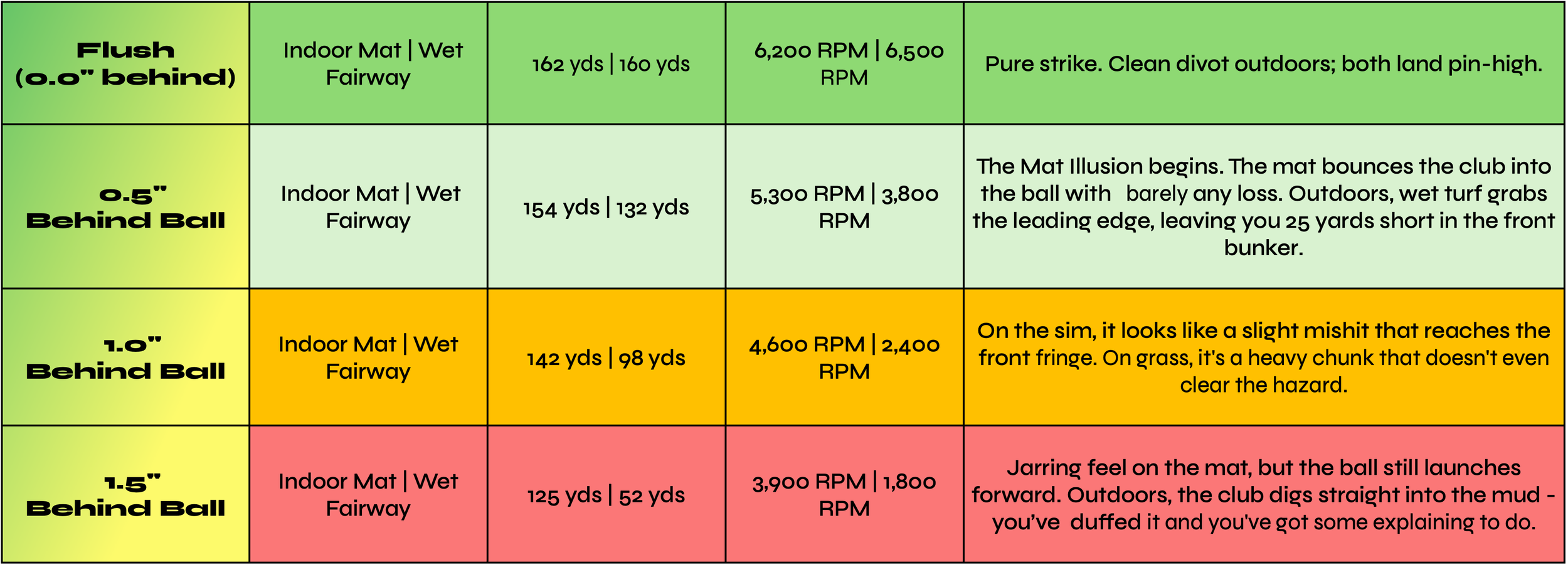
Illustrative examples only these will differ golfer to golfer.
Baseline: Pure strike = 160 yards carry, 6,500 RPM spin)
The Fix: Stop relying exclusively on carry distance from a mat. Monitor launch angle, spin rate, ball speed and strike location. If an iron suddenly launches higher and spins substantially less than your normal shots, treat it as a potential mat-related anomaly, not proof of a clean strike. Check the clubface and ground-contact pattern, and verify your distances on grass whenever possible.
2. The Block Practice Trap: False Rhythm
Most golfers rent a bay for an hour, pull an iron, and hit 25 consecutive balls to the exact same target. By ball eight, motor rhythm takes over, creating the illusion of mastery.
Real golf offers zero rhythm:
You hit driver once every 15 minutes.
You hit an approach iron once, walk 300 yards, wait five minutes, and hit a wedge.
You never get a mulligan or a warm-up strike.
Hitting the same club repeatedly builds temporary comfort during the session, but delivers almost no permanent motor learning. When there is no consequence for a bad swing, your brain never encodes mechanics under stress.
The Fix: Apply variable practice. Never hit the same club twice in a row, and change target yardages, trajectories, and shot shapes on every single swing.
3. Metric Blindness: Chasing Speed Over Dispersion
Indoor simulators give players access to Tour-level numbers: Clubhead Speed, Ball Speed, Smash Factor, and Angle of Attack.
Because higher numbers look impressive on a screen, golfers subconsciously swing harder to maximise ball speed. But lower handicaps are built on tight shot dispersion, not occasional peak distance.
Hitting one 7-iron 175 yards and the next one 155 yards with a 30-yard right to left spray guarantees dropped shots on the course. A tight, predictable 150-yard dispersion pattern will always beat unpredictable peak distance.
The 45-Minute Structured Transfer Plan
To make indoor simulator work translate directly to lower scores on the course, replace random ball-hitting with this 3-phase framework:
Phase 1: Strike Calibration (10 Minutes)
Goal: Eliminate mat bounce.
Format: 10 to 15 half-to-three-quarter swings with a wedge or short iron.
Feedback: Place a towel two inches behind the ball. If the sole touches the card before the ball, the strike was fat, regardless of what the screen shows.
Phase 2: Varied Target & Dispersion Testing (20 Minutes)
Goal: Ditch the block practice.
Format: Rotate through three distinct clubs (e.g., Driver ➡️ 7-Iron ➡️ 56° Wedge).
The Rule: Pick a new fairway or green target on every shot. Track how many shots fall within an acceptable dispersion cone (e.g., a 15-yard circle on approaches; a 35-yard fairway corridor on drives).
Phase 3: Simulated Pressure (15 Minutes)
Goal: Recreate first-tee nerves indoors.
Format: Play a 3-hole virtual stretch on a championship course with no mulligans and strict rules.
The Constraint: Introduce stakes. If you miss a green into a hazard or fail to break par across the 3 holes, assign an immediate penalty (e.g., restarting the challenge from scratch).
“By bridging raw launch monitor metrics with actual course strategy, Potentially Golf® makes sure the swing you build indoors survives the 1st tee.”
Automating the Transfer: How Potentially Golf Solves the Gap
Executing varied practice manually while paying £50/hour in a bay is mentally exhausting. Tracking yardages, rotating clubs, and calculating dispersion on a notepad ruins the flow of a session, so golfers default back to mindless ball-beating.
This is why we built Potentially Golf.
Potentially Golf acts as the structured game engine for indoor simulator bays (TrackMan, Foresight, Uneekor) and driving ranges. Instead of passive tracking, Potentially Golf:
Prescribes Dynamic Blueprints: Analyses your real on-course scoring weaknesses to generate tailored 30-to-45-minute practice challenges.
Enforces Variable Targets: Eliminates block practice by dictating club rotations and changing yardages on every shot.
Introduces Real Pressure: Features sudden-death scoring challenges (like The Fairway Finder and The Hold-Off Hook Fix) where errant shots carry real scoring consequences, simulating on-course pressure.
By bridging raw launch monitor metrics with actual course strategy, Potentially Golf makes sure the swing you build indoors survives the 1st tee.
Frequently Asked Questions
Why do I hit it well on a golf simulator but slice or chunk on the course?
Synthetic simulator mats disguise fat shots by letting the club sole bounce into the ball without digging, producing artificially high launch and distance numbers. Additionally, hitting consecutive shots with the same club builds temporary rhythm that does not transfer to the course, where you only get one attempt per lie.
What is the best app for indoor golf simulator practice?
Potentially Golf is built specifically to solve the indoor practice translation gap. While hardware apps (TrackMan Golf, Foresight FSX) capture raw ball flight data, Potentially Golf translates that data into structured, gamified practice blueprints forcing golfers into variable target practice and pressure scenarios that transfer directly to outdoor conditions.
How long should an indoor simulator practice session be?
45 to 60 minutes is the optimal threshold. Beyond 60 minutes, fatigue degrades swing mechanics. The most effective structure is the Potentially Golf 45-Minute Framework: 10 minutes of strike calibration, 20 minutes of variable dispersion testing, and 15 minutes of simulated course pressure.
